There are three ways to use AI in Microsoft Excel: Microsoft Copilot built into the ribbon, an AI add-in from the Office store such as GPT for Excel, and custom code with VBA or Office Scripts calling an AI API. The right method depends on your license, your data volume, and which AI models you need.
This guide covers all three, with setup steps, scale limits, and costs for each.
The three ways to use AI in Excel, compared
Method | What it is | Best for | Scale limits | Cost model | Where it breaks |
|---|---|---|---|---|---|
Microsoft Copilot | Microsoft's built-in AI side pane, with Agent Mode | Summaries, formulas, pivot tables, workbook questions | Conversational — one request at a time, no reliable bulk row-by-row runs | Standard access with a Copilot Chat-eligible Microsoft 365 business or enterprise plan, or a Personal/Family plan with AI credits; full experience with the Microsoft 365 Copilot add-on (about $30/user/month) or Microsoft 365 Premium | Bulk processing; speed — averaged 1m57s on tasks an add-in agent did in 16s in our March 2026 benchmark |
AI add-in (e.g. GPT for Excel) | Office add-in with an AI agent, bulk tools, and AI functions | Bulk row-by-row processing, everyday tasks by chat, choice of AI models | Up to 1 million rows in one run, at up to 1,000 answers per minute depending on model and task | Free trial, then a subscription from $25/seat with included usage | Requires installing an Excel add-in |
VBA / Office Scripts | Custom code calling an AI provider's API | Bespoke automations and pipelines | Whatever you engineer, within API rate limits | Free platform; you pay the AI provider per token | Requires coding, API key management, and ongoing maintenance |
The rest of this guide walks through each method: what it does well, what it costs, and where it stops being the right tool.
How to use Microsoft Copilot in Excel
Copilot is Microsoft's own AI, built into the Excel ribbon — no install needed. Open the Copilot pane, then ask in plain language: summarize this table, suggest a formula, build a pivot table, highlight outliers. Agent Mode lets it edit the workbook directly rather than just suggesting.
Access comes in two tiers. Work and school accounts on a Copilot Chat-eligible Microsoft 365 or Office 365 business or enterprise plan get standard access, as do individuals on a Microsoft 365 Personal or Family plan with AI credits; standard access is subject to service capacity and may be restricted at peak times. The Microsoft 365 Copilot add-on license (about $30 per user per month) for work and school accounts, or Microsoft 365 Premium for individuals, unlocks the full experience: priority access, advanced reasoning, and a choice of Claude or GPT models.
Where it shines: zero setup, workbook-level questions, quick analysis inside files you already have open.
Where it breaks: bulk row-by-row work. In our benchmark of AI agents for Excel (11 use cases, tested March 2026), Copilot averaged 1 minute 57 seconds on typical spreadsheet tasks that GPT for Excel completed in 16 seconds, and on bulk tasks it fell back to formula shortcuts or returned incomplete results. See the full comparison: GPT for Excel vs. Copilot in Excel.
A note on the COPILOT() function. Excel briefly had a native =COPILOT() formula for per-cell AI tasks, but Microsoft has announced it will no longer be available starting September 14, 2026, pointing users to the Copilot side pane instead. Don't build workflows on it — for formula-driven AI in Excel, add-in functions like =GPT() are the durable alternative.
How to use ChatGPT, Claude, and other AI models in Excel (add-ins)
Office add-ins connect Excel to AI models beyond Copilot — the latest ChatGPT and Claude models — and are built for work at a scale the native features don't handle.
For step-by-step setup, see how to connect ChatGPT to Microsoft Excel and how to connect Claude to Microsoft Excel.
GPT for Excel is built around an AI agent: you describe what you need in plain language, and it reads your data, drafts a plan, and executes it directly in your workbook — from writing formulas to processing up to 1 million rows in one run. In our March 2026 benchmark across 11 use cases, it averaged 16 seconds on typical spreadsheet tasks, against 50 seconds for Claude in Excel and 1 minute 57 seconds for Copilot — and it was the only agent to complete every bulk test, including 10,000 rows and 500 web searches.
How to install GPT for Excel
- Go to the GPT for Excel Word installation page on the Microsoft Marketplace.
- Click Open in Excel and confirm any permissions.
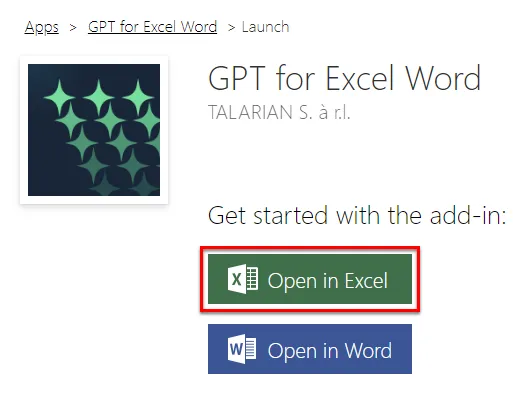
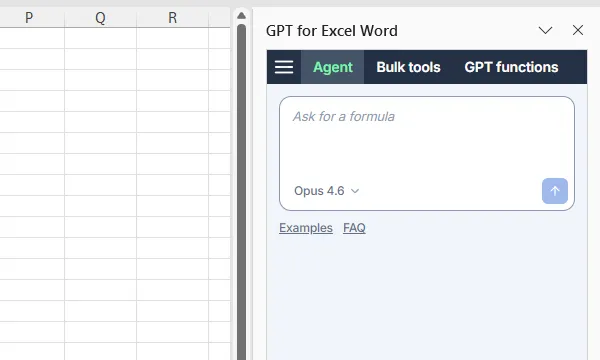
Once installed, open it from any workbook by clicking GPT for Excel Word in the Home tab (or Home > Add-ins > My Add-ins). The sidebar appears on the right. No API key is required, and the add-in comes with free starting credits.
How to use the AI agent
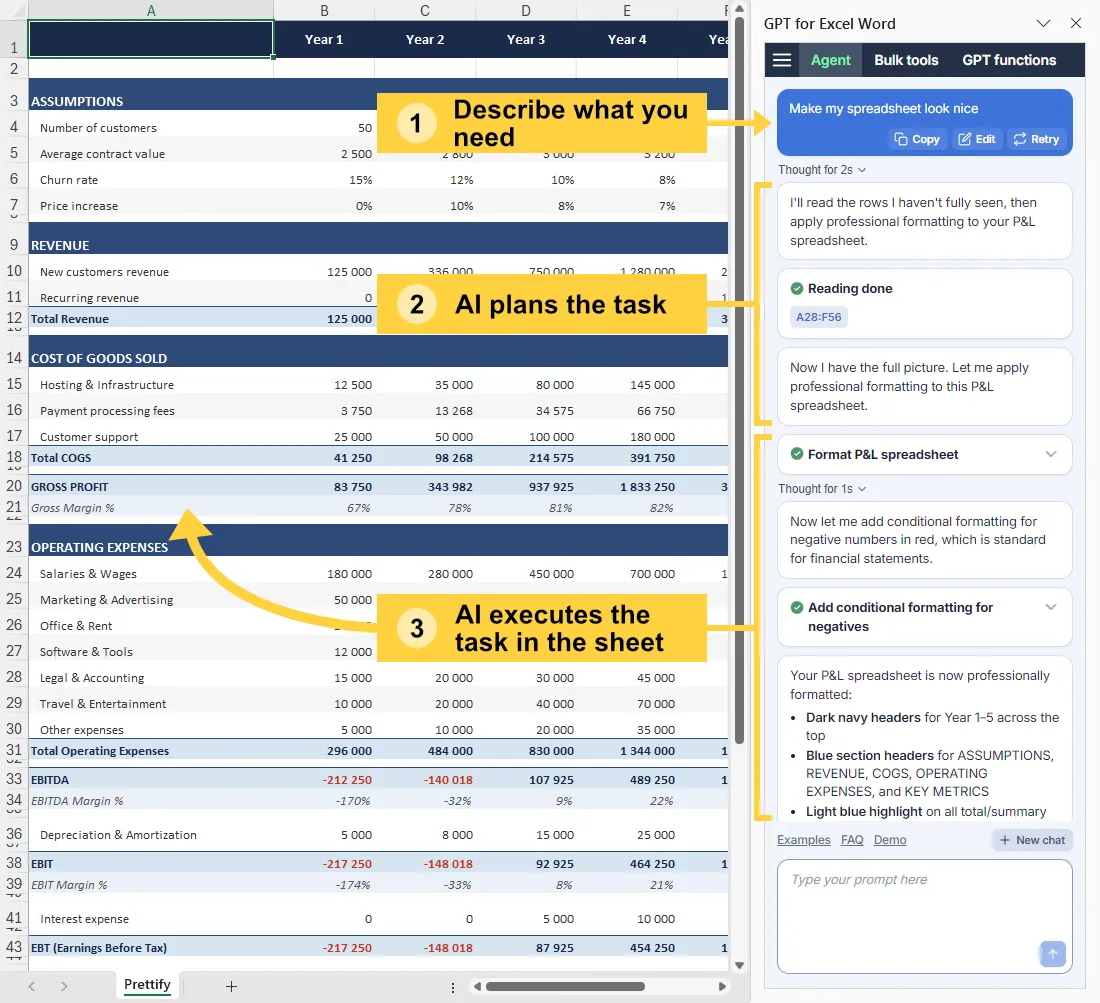
The Agent is the chat interface for spreadsheet work. Describe what you need — Fill out this table, Translate column B to French, Fix the formula in H2 — and the Agent analyzes your request, drafts a plan, and executes it. You can follow its progress live in the sidebar.
The fastest way to see it in action is a built-in example:
- In the Agent tab, click Examples and select Market research.
- GPT for Excel creates a sheet with sample data — company names and empty columns.
- Click send on the prefilled prompt:
Fill out this table. The Agent searches the web for each company and fills in the missing information, column by column.
What you can do with an AI add-in
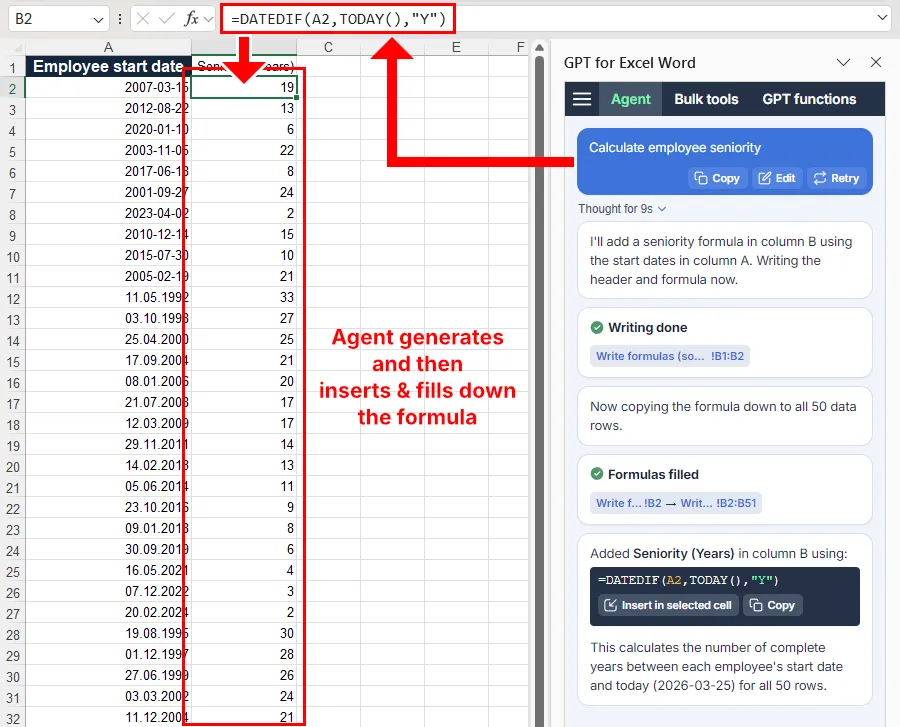
Everyday spreadsheet tasks — the Agent writes and fixes formulas, formats and standardizes messy data, and builds charts and pivot tables from a plain-language description.
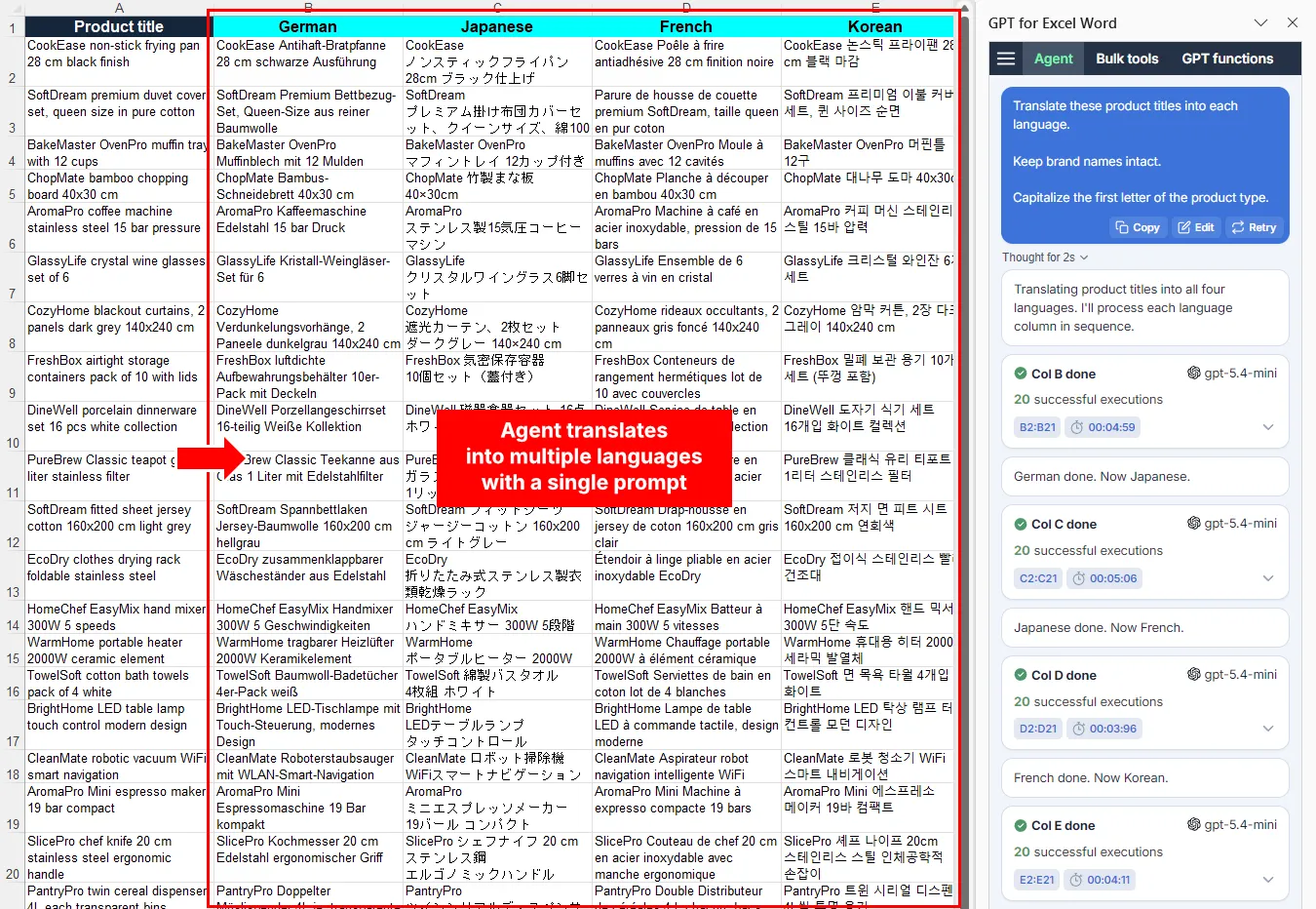
Bulk row-by-row processing — the work Copilot doesn't do at scale:
- Translate at scale. Product descriptions, customer tickets, any column, into one or more languages, with glossary support.
- Generate content. SEO product descriptions, ad copy, or summaries — a unique result for every row from a single prompt.
- Enrich data. The Agent searches the web to fill in missing company details, contact data, or market intelligence.
- Categorize and score. Classify support tickets, tag survey responses, or qualify leads against your criteria.
Beyond the Agent, GPT for Excel also includes bulk tools (row-by-row processing with manual control over prompt, model, and settings) and GPT functions (custom formulas like =GPT() for reactive, formula-driven workflows — with no scheduled retirement). Start with the Agent; reach for the others when you need finer control.
What an AI add-in costs
GPT for Excel comes with a free trial — free starting credits, no card required. After the trial, it's a monthly subscription with included usage (from $25 per seat); when a seat's quota runs out, you can buy shared extra-usage credits. On Business and Enterprise plans you can also bring your own API key and pay your provider directly, plus a platform fee of $1 per 1,000 requests. See pricing.
How to use VBA or Office Scripts with an AI API in Excel
If you can code, you can call any AI provider's API from Excel yourself. In desktop Excel, VBA can send HTTP requests to an AI API with your own key. In Excel on the web and Microsoft 365, Office Scripts (TypeScript) does the same and pairs with Power Automate for scheduled flows.
This is the right method when you're building a bespoke pipeline — recurring enrichment jobs, custom integrations, logic no off-the-shelf tool covers. The platform is free; you pay your AI provider per token.
The trade-off is that you own an engineering project: API key storage, rate-limit handling, retries, and maintenance every time the API or your requirements change. For standard bulk work, an add-in gets you the same result without the code. (For background on macros themselves, see what Excel macros are and how to use them.)
Which method should you use?
- You have a Copilot license and want quick analysis → Microsoft Copilot. It's already in the ribbon.
- You want AI inside formulas → an add-in's AI functions, like
=GPT(). Excel's native COPILOT() function retires on September 14, 2026. - You process data at scale, or need models beyond Copilot → an add-in. GPT for Excel handles up to 1 million rows in one run with the latest ChatGPT and Claude models.
- You're building a custom pipeline and can code → VBA or Office Scripts plus an AI API.
These methods aren't exclusive: plenty of teams use Copilot for ad-hoc questions and an add-in for production bulk work.
Frequently asked questions
Does Excel have built-in AI?
Yes. Microsoft Copilot sits in the Excel ribbon with no install needed — it summarizes data, writes formulas, builds pivot tables, and can edit your workbook in Agent Mode. Copilot Chat-eligible Microsoft 365 business and enterprise plans, and Personal or Family plans with AI credits, include standard access; the Microsoft 365 Copilot add-on license (about $30 per user per month) or Microsoft 365 Premium unlocks the full experience, including priority access and model choice.
Is the COPILOT() function going away?
Yes. Microsoft has announced that the COPILOT function will no longer be available starting September 14, 2026, and recommends the Copilot side pane instead. While it lasts, it is limited to 100 calculations per 10 minutes and cannot access workbook data beyond the cells you reference. Add-in AI functions like =GPT() are the durable formula-based alternative.
How do I add ChatGPT to Excel?
Install an AI add-in. GPT for Excel gives you the latest ChatGPT and Claude models through an AI agent you instruct in plain language, plus bulk tools and custom functions like =GPT(). Open it from the Home tab after installing from the Microsoft Marketplace.
Can AI process thousands of rows in Excel?
Yes, with an add-in. Copilot doesn't support bulk row-by-row processing, but GPT for Excel processes up to 1 million rows in one run — translating, categorizing, enriching, or generating a unique result per row — at up to 1,000 answers per minute depending on model and task.
What is the fastest AI for Excel?
In our benchmark of AI agents for Excel (11 use cases, tested March 2026), GPT for Excel averaged 16 seconds on typical spreadsheet tasks, against 50 seconds for Claude in Excel and 1 minute 57 seconds for Microsoft Copilot — and it was the only agent to complete every bulk test, including 10,000 rows.
Is GPT for Excel free?
GPT for Excel comes with a free trial: it's free to install, with free starting credits and no card required. After the trial, usage is covered by a monthly subscription with included usage (from $25 per seat), plus shared extra-usage credits when you need more.
Get started
- Install GPT for Excel from the Microsoft Marketplace. No API key required.
- Open the Agent from the Home tab.
- Describe what you need and let the AI do the work.